Showing posts with label Veeru. Show all posts

Monday, March 6, 2023

Sholay and the Western Genre: Exploring the Western influences in the film


Sholay is a classic Indian film released in 1975 that has become a cultural icon in India. The film, directed by Ramesh Sippy, was heavily influenced by the Western genre and transformed the Indian film industry by introducing a new style of storytelling and filmmaking.

Cowboys, gun battles, wild wild west: The Western genre has been a popular and enduring genre in cinema history, characterized by its depictions of the American West, cowboys, outlaws, and lawmen. Sholay incorporated several elements of the Western genre, including its setting in a small village in the Indian state of Uttar Pradesh, a story of revenge, and the portrayal of larger-than-life characters.

Nowhere do writers Salim-Javed copy any situation or scene for the Hollywood or the Sergio Leone classic westerns. The family execution scene has an echo from Leone's Once Upon a Time in the West (1968), that's it for any direct influences. The westerns impact is widely visible in the cinematography and minimal use of background score in key action sequences. 

The anti-hero: One of the most significant Western influences in Sholay was its use of the "anti-hero" archetype. In Western films, anti-heroes are often portrayed as flawed characters who possess qualities that make them less than heroic, such as greed or a lack of morality. Sholay's character of Gabbar Singh, played by Amjad Khan, was an anti-hero who was ruthless, violent, and lacked any redeeming qualities. Gabbar Singh was unlike any villain that Indian cinema had seen before, and his portrayal was groundbreaking in the context of Indian cinema.

Buddy system: Another Western influence in Sholay was its use of the "buddy film" trope. In Western films, the buddy film is a popular subgenre that typically features two protagonists who form an unlikely bond and work together to achieve a common goal. Sholay's protagonists, Veeru and Jai, played by Dharmendra and Amitabh Bachchan, respectively, were two very different characters who became friends and worked together to defeat the film's antagonist.

R.D. Burman: Sholay's use of music was also heavily influenced by Western cinema. Western films often use music to enhance the mood and atmosphere of a scene, and Sholay was no different. The film's iconic soundtrack, composed by R.D. Burman, was a fusion of Indian classical music and Western-inspired tunes. 

The use of music in Sholay was revolutionary and set a new standard for Indian cinema. My favourite is the opening credits score, that is at once western yet organically Indian. 

Sholay was a game-changer for the Indian film industry. It transformed the way Indian filmmakers approached storytelling and introduced a new level of technical excellence to Indian cinema. The film's success paved the way for a new era of Hindi cinema, and its influence can still be seen in Indian films today.

Wednesday, January 1, 2014

Sholay in 3D: Trailer Stills II

One of the many 3D effects from the film
Another poetic dacoit fall, another hapless horse
Thakur gets a measure of Gabbar's neck
Veeru has his 'Nana Patekar' moment

Chitti aayi hai...: Gabbar reads a letter

Sunday, September 22, 2013

Sholay Moments: Robbers, Widows and Safes


In their first interaction with Thakur, Veeru makes it clear why he and Jai are thieves. In a brash and rough tongue he puts in one single word - "Paisa" ("Money").Yet, the duo has its money principles, there is no hint as to where they get their noble intentions from.What we do know it that Hindi film heroes can go from rogue to good in the matter of seconds.


At their arrival at Ramgarh, the duo has no intention of helping Thakur Baldev Singh. Having received advance payment and provided a generous view of the family safe, it is decided that they while the day away in sleep and clear out the safe at night and escape. Only, Radha catches them in the act and instead of screaming,"Thieves, help!", she is strangely maudlin.The widow does the unthinkable, she hands over the safe's keys and asks them to make away with the money. Her point is - at least that will convince Thakur, her father-in-law that the duo are crooks after all.


Radha must have done some serious criminal psychology reading, or it must have been her semi-transparent white sari that did the trick. For, in an inexplicable Hindi film u-turn, Jai returns the keys to Radha the next morning with the promise that they will not repeat the act again.

Moral of the story: Once a Hindi film hero turns good, nobody can bring them to the bad side. Ever. If a beautiful heroine is responsible for the transformation, Satan can readily apply for retirement.   

Thursday, September 19, 2013

Sholay Moments: Who will take Basanti Home?


A major dilemma in Sholay's final moments and certainly an awkward one. Who the hell will take Basanti home? Veeru or Jai? They could have left it to the horse too. Basanti was an expert in riding the tanga, so surely, surely, surely she could ride back to Ramgarh on horseback. Was it about chivalry then? What were Veeru and Jai afraid of? That Gabbar's pack would catch up with Basanti and hold her at ransom? 

The decision is finally made by Jai, when a machine gun bullet finally catches up with a Hindi film hero, right on the back. Even as Jai jumps to safety, we must understand that neither Veeru or Basanti have seen the wound. It is a moment of great sacrifice and we can only watch when Jai tosses the fatal coin and thus seals his fate. 

Amrish Puri in Mr. India

Bullets and Heroes (Before Rajnikanth) 
I could go on and on about the bullet that first gets Jai. There are very few Hindi film heroes who have been felled by enemy fire post Sholay, all through the trashy eighties and redundant nineties. If either Amrish Puri, Ranjit, Gulshan Grover or Prem Chopra finally did get to the gun, there was always a sister, mother, evil brother gone good, vamp turned pure woman, or former lover (lesser paid heroine) who would dive in lightning speed to save the hero. Then bloody and dying, they would make their final speeches, if needed bring the hero and heroine's hands together and then pass away in a twist of head on cosy denim hero lap. 

Sholay and Spoofs
Not a long time ago, when MTV and V used to be music channels with a few laughs lined up in between (Quick Gun Murugan, The Liftman, etc) there were some funny spoofs done on Sholay. One tickling series, shows how Jai steals Basanti from Veeru, even as the latter is haplessly bonded by friendship. Hence in the reenactment of the final scenes, Jai tricks Veeru to stay back by the toss of the coin and thus makes away with Basanti. If Sholay were to be remade as an epic story of betrayal, Jai would have made a bigger name as a villain and even Gabbar would have roared in disgust, "Dikkar hai!" So much for alternatives.    

Tuesday, November 9, 2010

Coming Soon: Ramgarh Resort & Spa!

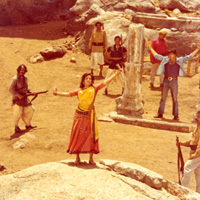
Naach, Basanti, Naach!

Scheduled to open on August 2011,the Ramgarh Resort & Spa will bring Sholay back to life again at Ramnagaram, the now famous location where most of the film was shot. At least that is what a newspaper report by Saritha Rai in The Indian Express says.

Set to be the first resort to be based on a Hindi movie, the Resort & Spa will cover over 6.6 acres of rocky terrain. As Rai informs us - A hostess dressed as Basanti could lead guests in the restaurants Gabbar ka Adda or Thakur ki Haveli. A masseur dressed as Gabbar Singh could give a visitor a soothing massage at the spa, which stands at the spot where a thrilling horse chase was filmed for the movie.

Last heard, the resort owners were searching for a Thakur Baldev Singh look-alike, for the post of the resort manager. Guests would be able to indulge in rappelling, horse-riding and games centred around the movie. 

One hurdle could be the copyright issues, as the Sippy's have always been against the misuse of their brand.